When You Know Other People Have Purchased the Same Brand That You Are Buying, the Feeling Is Called:
iii.1 Factors That Influence Consumers' Ownership Behavior
Learning Objectives
- Draw the personal and psychological factors that may influence what consumers buy and when they buy it.
- Explain what marketing professionals can do to influence consumers' behavior.
- Explicate how looking at lifestyle data helps firms understand what consumers desire to purchase.
- Explain how Maslow's bureaucracy of needs works.
- Explain how culture, subcultures, social classes, families, and reference groups bear on consumers' buying behavior.
You've been a consumer with purchasing power for much longer than you probably realize—since the get-go time you were asked which cereal or toy you wanted. Over the years, yous've developed rules of thumb or mental shortcuts providing a systematic way to choose among alternatives, fifty-fifty if you aren't aware of it. Other consumers follow a like process, but different people, no affair how like they are, brand different purchasing decisions. You might be very interested in purchasing a Smart Auto, but your all-time friend might want to purchase a Ford F-150 truck. What factors influenced your decision and what factors influenced your friend'due south decision?
Equally we mentioned earlier in the chapter, consumer behavior is influenced by many things, including environmental and marketing factors, the state of affairs, personal and psychological factors, family, and culture. Businesses try to figure out trends then they tin can reach the people well-nigh likely to purchase their products in the most cost-effective mode possible. Businesses often try to influence a consumer's behavior with things they can command such as the layout of a store, music, grouping and availability of products, pricing, and advertising. While some influences may exist temporary and others are long lasting, different factors can bear on how buyers deport—whether they influence you to make a purchase, buy additional products, or buy zilch at all. Allow'southward now expect at some of the influences on consumer behavior in more particular.
Situational Factors
Take you ever been in a department story and couldn't find your mode out? No, you aren't necessarily directionally challenged. Marketing professionals take physical factors such as a store's design and layout into account when they are designing their facilities. Presumably, the longer you wander effectually a facility, the more you will spend. Grocery stores often place breadstuff and milk products on the opposite ends of the stores considering people ofttimes need both types of products. To buy both, they have to walk around an entire store, which of course, is loaded with other items they might run into and buy.
Store locations also influence behavior. Starbucks has done a skillful chore in terms of locating its stores. It has the procedure downwards to a science; you can scarcely drive a few miles down the road without passing a Starbucks. You tin also buy cups of Starbucks coffee at many grocery stores and in airports—almost any place where in that location is foot traffic.
Concrete factors that firms can control, such as the layout of a store, music played at stores, the lighting, temperature, and fifty-fifty the smells you feel are chosen atmospherics. Perhaps you've visited the role of an apartment circuitous and noticed how great it looked and even smelled. It's no coincidence. The managers of the complex were trying to get y'all to stay for a while and have a look at their facilities. Enquiry shows that "strategic fragrancing" results in customers staying in stores longer, buying more, and leaving with better impressions of the quality of stores' services and products. Mirrors near hotel elevators are another example. Hotel operators have found that when people are decorated looking at themselves in the mirrors, they don't feel like they are waiting as long for their elevators (Moore, 2008).
Non all concrete factors are under a company'southward command, however. Take weather, for example. Rainy weather can be a boon to some companies, like umbrella makers such as Totes, but a trouble for others. Beach resorts, outdoor concert venues, and golf game courses suffer when information technology is raining heavily. Businesses such as car dealers also have fewer customers. Who wants to shop for a automobile in the rain?
Firms often effort to deal with agin concrete factors such every bit bad weather by offering specials during unattractive times. For example, many resorts offer consumers discounts to travel to beach locations during hurricane flavour. Having an online presence is another fashion to cope with weather-related bug. What could be more than comfortable than shopping at abode? If it'southward raining too hard to drive to the GAP, REI, or Abercrombie & Fitch, y'all can buy products from these companies and many others online. Y'all can shop online for cars, too, and many restaurants take orders online and deliver.
Crowding is another situational factor. Have you e'er left a store and not purchased anything considering it was just also crowded? Some studies accept shown that consumers experience better about retailers who endeavor to prevent overcrowding in their stores. However, other studies have shown that to a certain extent, crowding tin accept a positive impact on a person'due south ownership experience. The phenomenon is oftentimes referred to as "herd beliefs" (Gaumer & Leif, 2005).
If people are lined up to buy something, yous want to know why. Should you make it line to buy information technology too? Herd behavior helped bulldoze up the price of houses in the mid-2000s before the prices for them rapidly fell. Unfortunately, herd behavior has also led to the deaths of people. In 2008, a store employee was trampled to death past an early morn crowd rushing into a Walmart to snap up vacation bargains.
Social Situation
The social situation you're in tin can significantly affect your purchase beliefs. Possibly you lot accept seen Girl Scouts selling cookies outside grocery stores and other retail establishments and purchased zero from them, just what if your neighbor's daughter is selling the cookies? Are you going to turn her down or be a friendly neighbor and buy a box (or two)?
Video Clip
Thin Mints, Anyone?
(click to see video)
Are you going to plough down cookies from this cute Girl Scout? What if she'south your neighbor's daughter? Pass the milk, please!
Companies like Pampered Chef that sell their products at parties sympathize that the social situation makes a difference. When you're at a friend's Pampered Chef party, you don't want to look cheap or disappoint your friend past not ownership anything. Sure social situations can also make you less willing to purchase products. You might spend quite a bit of money each month eating at fast-food restaurants like McDonald'due south and Subway. Where do you take someone for your offset appointment? Some people might take a get-go engagement to Subway, but other people would peradventure choose a restaurant that's more upscale. Likewise, if yous have turned downward a drinkable or dessert on a date because you were worried about what the person you lot were with might have thought, your consumption was afflicted past your social state of affairs (Matilla & Wirtz, 2008).
Time
The time of mean solar day, fourth dimension of year, and how much time consumers experience similar they have to store affect what they buy. Researchers have even discovered whether someone is a "morning person" or "evening person" affects shopping patterns. Take yous always gone to the grocery store when you lot are hungry or after pay day when you accept cash in your pocket? When you are hungry or take cash, you may buy more than than you would at other times. Seven-Xi Japan is a company that's extremely in tune to time and how it affects buyers. The company's point-of-sale systems at its checkout counters monitor what is selling well and when, and stores are restocked with those items immediately—sometimes via motorbike deliveries that zip in and out of traffic along Japan's crowded streets. The goal is to get the products on the shelves when and where consumers want them. Seven-Eleven Nihon also knows that, like Americans, its customers are "fourth dimension starved." Shoppers can pay their utility bills, local taxes, and insurance or alimony premiums at Seven-11 Japan stores, and even make photocopies (Bird, 2002).
Companies worldwide are enlightened of people's lack of time and are finding ways to conform them. Some doctors' offices offer drive-through shots for patients who are in a hurry and for elderly patients who detect it difficult to get out of their cars. Tickets.com allows companies to sell tickets by sending them to customers' mobile phones when they call in. The phones' displays are and then read past barcode scanners when the ticket purchasers get in at the events they're attending. Likewise, if you lot need customer service from Amazon.com, there's no need to wait on the telephone. If you take an account with Amazon, you only click a button on the company's Web site and an Amazon representative calls yous immediately.
Reason for the Purchase
The reason you are shopping also affects the amount of time you volition spend shopping. Are yous making an emergency purchase? What if you need something for an of import dinner or a project and but have an hour to get everything? Are you shopping for a gift or for a special occasion? Are you buying something to consummate a task/project and need information technology quickly? In recent years, emergency clinics have sprung up in strip malls all over the country. Convenience is one reason. The other is sheer necessity. If you cut yourself and you are bleeding badly, y'all're probably not going to store around much to find the best clinic. Y'all will go to the one that's closest to y'all. The same thing may happen if you need something immediately.
Purchasing a gift might not be an emergency situation, only you might non want to spend much time shopping for it either. Gift certificates have been pop for years. You tin can buy souvenir cards for numerous merchants at your local grocery shop or online. By contrast, suppose you demand to purchase an engagement ring. Certain, yous could buy one online in a jiffy, just you probably wouldn't do that. What if the diamond was fake? What if your meaning other turned you down and you had to return the ring? How difficult would it be to get dorsum online and return the ring? (Hornik & Miniero, 2009)
Mood
Have yous always felt like going on a shopping spree? At other times wild horses couldn't drag you to a mall. People's moods temporarily affect their spending patterns. Some people enjoy shopping. It'due south entertaining for them. At the extreme are compulsive spenders who get a temporary "loftier" from spending.
A sour mood can spoil a consumer's want to store. The crash of the U.S. stock market in 2008 left many people feeling poorer, leading to a dramatic downturn in consumer spending. Penny pinching came into vogue, and conspicuous spending was out. Costco and Walmart experienced heightened sales of their low-cost Kirkland Signature and Slap-up Value brands as consumers scrimped1. Saks Fifth Avenue wasn't so lucky. Its annual release of spring fashions usually leads to a feeding frenzy among shoppers, but spring 2009 was different. "We've definitely seen a drop-off of this idea of shopping for entertainment," says Kimberly Grabel, Saks Fifth Avenue's senior vice president of marketing (Rosenbloom, 2009). To get buyers in the shopping mood, companies resorted to different measures. The upscale retailer Neiman Marcus began introducing more mid-priced brands. By studying customer'south loyalty cards, the French hypermarket Carrefour hoped to find ways to get its customers to purchase nonfood items that have higher profit margins.
The glum mood wasn't bad for all businesses though. Discounters like One-half-Priced books saw their sales surge. So did seed sellers as people began planting their ain gardens. Finally, what almost those products (Aqua Globes, Snuggies, and Ped Eggs) yous come across being hawked on television? Their sales were the all-time e'er. Apparently, consumers too broke to proceed holiday or shop at Saks were instead watching television and treating themselves to the products (Ward, 2009).
Personal Factors
Personality and Cocky-Concept
Personality describes a person'southward disposition, helps prove why people are unlike, and encompasses a person's unique traits. The "Large Five" personality traits that psychologists discuss ofttimes include openness or how open up y'all are to new experiences, conscientiousness or how diligent y'all are, extraversion or how outgoing or shy you are, agreeableness or how piece of cake you lot are to get along with, and neuroticism or how prone you are to negative mental states.
Practice personality traits predict people's purchasing behavior? Can companies successfully target certain products to people based on their personalities? How do you find out what personalities consumers take? Are extraverts wild spenders and introverts penny pinchers?
The link between people'southward personalities and their buying behavior is somewhat unclear. Some research studies accept shown that "sensation seekers," or people who exhibit extremely high levels of openness, are more likely to respond well to advertising that's violent and graphic. The problem for firms is figuring out "who's who" in terms of their personalities.
Marketers have had meliorate luck linking people'due south self-concepts to their ownership behavior. Your cocky-concept is how you lot run into yourself—be it positive or negative. Your ideal self is how y'all would like to run across yourself—whether information technology'due south prettier, more popular, more eco-witting, or more "goth," and others' self-concept, or how y'all remember others meet y'all, likewise influences your buy beliefs. Marketing researchers believe people purchase products to enhance how they feel nigh themselves—to get themselves closer to their platonic selves.
The slogan "Be All That You Can Be," which for years was used by the U.S. Regular army to recruit soldiers, is an attempt to appeal to the self-concept. Presumably, by joining the U.S. Army, you will become a improve version of yourself, which volition, in plow, improve your life. Many beauty products and corrective procedures are advertised in a way that'south supposed to appeal to the platonic self people seek. All of u.s. desire products that ameliorate our lives.
Gender, Historic period, and Stage of Life
While demographic variables such as income, education, and marital status are important, we will look at gender, age, and stage of life and how they influence purchase decisions. Men and women need and purchase dissimilar products (Ward & Thuhang, 2007). They also shop differently and in general, have different attitudes about shopping. Yous know the old stereotypes. Men see what they want and buy it, simply women "endeavour on everything and shop 'til they drib." In that location's some truth to the stereotypes. That's why you meet so many advertisements directed at 1 sex or the other—beer commercials that air on ESPN and commercials for household products that air on Lifetime. Women influence fully two-thirds of all household product purchases, whereas men buy about three-quarters of all alcoholic beverages (Schmitt, 2008). The shopping differences betwixt men and women seem to be changing, though. Younger, well-educated men are less probable to believe grocery shopping is a woman's job and would exist more than inclined to deal shop and use coupons if the coupons were properly targeted at them (Hill & Harmon, 2007). One survey institute that approximately 45 percentage of married men actually like shopping and consider it relaxing.
1 study by Resources Interactive, a applied science research firm, found that when shopping online, men adopt sites with lots of pictures of products and women prefer to see products online in lifestyle context—say, a lamp in a living room. Women are besides twice equally likely as men to use viewing tools such every bit the zoom and rotate buttons and links that allow them to modify the color of products.
Video Clip
What Women Want versus What Men Desire
(click to encounter video)
Check out this Heineken commercial, which highlights the differences between "what women desire" and "what men want" when it comes to products.
Figure 3.two

Marketing to men is large business organization. Some advertising agencies specialize in advertisements designed specifically to appeal to male consumers.
Many businesses today are taking greater pains to figure out "what men desire." Products such as face toners and body washes for men such equally the Axe brand and hair salons such as the Men's Zone and Weldon Barber are a relatively new phenomenon. Some advertizement agencies specialize in advertising directed at men. There are too many products such as kayaks and mount bikes targeted toward women that weren't in the by.
You have probably noticed that the things you lot purchase have changed as you age. Call back well-nigh what yous wanted and how you spent five dollars when you were a child, a teenager, and an adult. When y'all were a child, the last thing you probably wanted as a gift was vesture. Equally you lot became a teen, withal, cool apparel probably became a bigger priority. Don't expect at present, only depending on the stage of life you're currently in, diapers and wrinkle foam might exist just around the corner.
If you're single and working after graduation, you lot probably spend your money differently than a newly married couple. How exercise you think spending patterns alter when someone has a young child or a teenager or a kid in college? Diapers and solar day care, orthodontia, tuition, electronics—regardless of the age, children affect the spending patterns of families. In one case children graduate from college and parents are empty nesters, spending patterns change over again.
Empty nesters and infant boomers are a huge market that companies are trying to tap. Ford and other car companies have created "aging suits" for young employees to wear when they're designing automobilesii. The arrange simulates the restricted mobility and vision people feel as they go older. Auto designers can then figure out how to configure the automobiles to better meet the needs of these consumers.
Video Clip
Car Makers Design Special Crumbling Adapt
(click to run into video)
The "aging suit" has elastic bindings that hamper a car designer's movement and goggles that simulate deteriorating eyesight. The suit gives the designer an idea what kinds of car-related challenges older consumers face.
Lisa Rudes Sandel, the founder of Not Your Daughter's Jeans (NYDJ), created a multimillion-dollar business by designing jeans for baby boomers with womanly bodies. Since its launch seven years ago, NYDJ has become the largest domestic manufacturer of women'south jeans under $100. "The truth is," Rudes Sandel says, "I've never forgotten that woman I've been aiming for since 24-hour interval ane." Rudes Sandel "speaks to" every one of her customers via a note tucked into each pair of jean that reads, "NYDJ (Not Your Daughter's Jeans) cannot be held responsible for whatever positive event that may arise due to your fabled appearance when wearing the Tummy Tuck jeans. You lot can give thanks me later" (Saffian, 2009).
Figure iii.iii
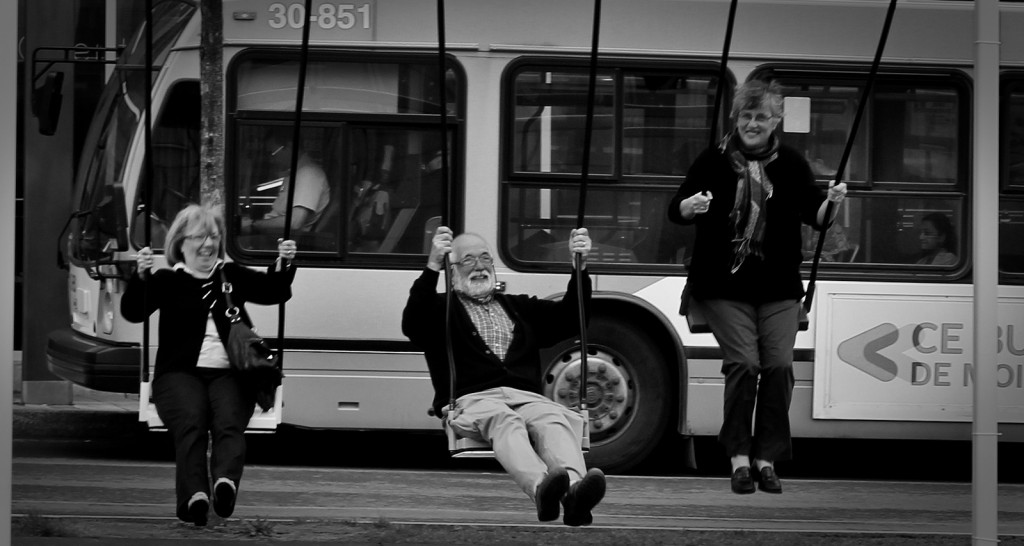
You lot're only every bit old as you feel—and the things y'all buy.
Your chronological age, or actual age in years, is ane matter. Your cognitive historic period, or how old you perceive yourself to be, is another. A person'southward cerebral age affects his or her activities and sparks interests consistent with his or her perceived historic period (Barak & Gould, 1985). Cerebral historic period is a significant predictor of consumer behaviors, including people'southward dining out, watching television, going to bars and dance clubs, playing calculator games, and shopping (Barak & Gould, 1985). Companies take institute that many consumers feel younger than their chronological age and don't have kindly to products that feature "old folks" because they tin can't identify with them.
Lifestyle
If you have ever watched the television set show Married woman Swap, you tin can see that despite people's similarities (e.g., being middle-course Americans who are married with children), their lifestyles can differ radically. To better understand and connect with consumers, companies interview or ask people to consummate questionnaires well-nigh their lifestyles or their activities, interests, and opinions (often referred to as AIO statements). Consumers are non simply asked nigh products they similar, where they live, and what their gender is simply also well-nigh what they do—that is, how they spend their time and what their priorities, values, opinions, and general outlooks on the world are. Where practice they go other than work? Who practice they like to talk to? What practise they talk well-nigh? Researchers hired by Procter & Gamble have gone then far as to follow women around for weeks as they store, run errands, and socialize with one another (Berner, 2006). Other companies have paid people to go along a daily journal of their activities and routines.
A number of research organizations examine lifestyle and psychographic characteristics of consumers. Psychographics combines the lifestyle traits of consumers and their personality styles with an analysis of their attitudes, activities, and values to make up one's mind groups of consumers with similar characteristics. 1 of the most widely used systems to classify people based on psychographics is the VALS (Values, Attitudes, and Lifestyles) framework. Using VALS to combine psychographics with demographic information such as marital status, education level, and income provide a better understanding of consumers.
Psychological Factors
Motivation
Motivation is the inward drive we have to get what nosotros need. In the mid-1900s, Abraham Maslow, an American psychologist, developed the hierarchy of needs shown in Figure three.four "Maslow's Hierarchy of Needs".
Figure three.4 Maslow's Hierarchy of Needs
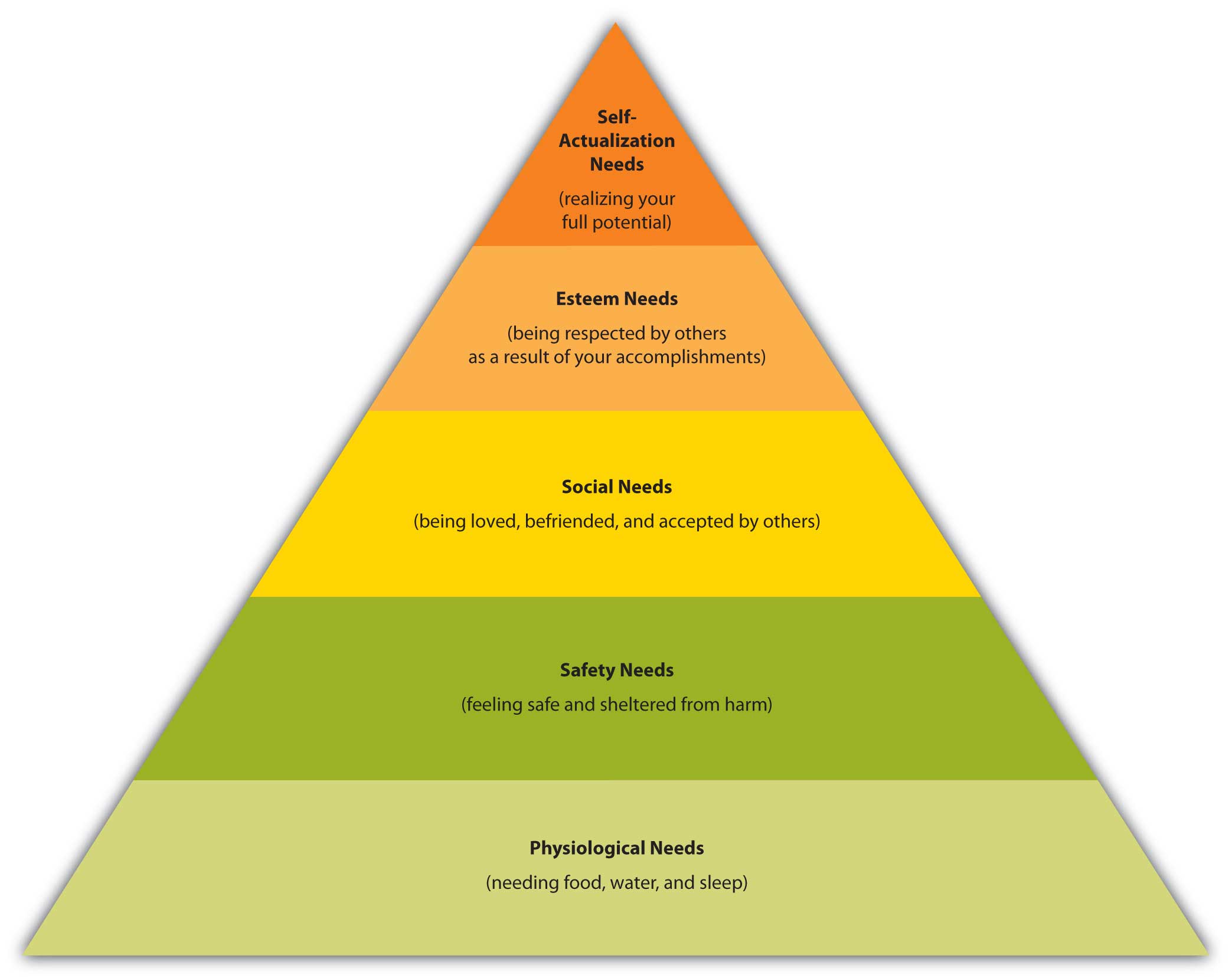
Maslow theorized that people take to fulfill their basic needs—food, water, and sleep—earlier they tin can begin fulfilling college-level needs. Have you ever gone shopping when you were tired or hungry? Even if you were shopping for something that would brand you the envy of your friends (maybe a new car) you probably wanted to slumber or consume even more. (Forget the car. Just give me a nap and a processed bar.)
The need for food is recurring. Other needs, such every bit shelter, clothing, and safety, tend to be enduring. Still other needs arise at different points in fourth dimension in a person'south life. For example, during course schoolhouse and high school, your social needs probably rose to the forefront. You wanted to accept friends and get a appointment. Perhaps this prompted you to buy certain types of clothing or electronic devices. Subsequently high school, you lot began thinking about how people would view y'all in your "station" in life, so you decided to pay for college and get a professional degree, thereby fulfilling your need for esteem. If you lot're lucky, at some indicate you will realize Maslow'due south state of cocky-appearing. Y'all volition believe you accept go the person in life that you lot feel you were meant to be.
Following the economic crisis that began in 2008, the sales of new automobiles dropped sharply nearly everywhere effectually the globe—except the sales of Hyundai vehicles. Hyundai understood that people needed to experience secure and prophylactic and ran an ad entrada that bodacious car buyers they could return their vehicles if they couldn't make the payments on them without damaging their credit. Seeing Hyundai'south success, other carmakers began offering like programs. Likewise, banks began offer "worry-gratuitous" mortgages to ease the minds of would-be homebuyers. For a fee of nearly $500, Beginning Mortgage Corp., a Texas-based bank, offered to make a homeowner's mortgage payment for half dozen months if he or she got laid off (Jares, 2010).
While achieving cocky-actualization may be a goal for many individuals in the United States, consumers in Eastern cultures may focus more on belongingness and group needs. Marketers look at cultural differences in addition to private needs. The importance of groups affects advertising (using groups versus individuals) and product decisions.
Perception
Perception is how you lot translate the world around you and make sense of it in your brain. You lot do so via stimuli that impact your different senses—sight, hearing, affect, odor, and sense of taste. How you combine these senses also makes a divergence. For example, in one report, consumers were blindfolded and asked to potable a new brand of clear beer. Most of them said the product tasted like regular beer. However, when the blindfolds came off and they drank the beer, many of them described information technology every bit "watery" tasting (Ries, 2009).
Consumers are bombarded with messages on television, radio, magazines, the Internet, and even bathroom walls. The average consumer is exposed to about three one thousand advertisements per day (Lasn, 1999). Consumers are surfing the Internet, watching television, and checking their cell phones for text messages simultaneously. Some, but not all, information makes it into our brains. Selecting information we see or hear (east.g., television shows or magazines) is called selective exposure.
Have you ever read or thought about something and and so started noticing ads and information most it popping upward everywhere? Many people are more perceptive to advertisements for products they demand. Selective attention is the process of filtering out information based on how relevant it is to you. It's been described every bit a "suit of armor" that helps you filter out information yous don't need. At other times, people forget data, even if it's quite relevant to them, which is called selective retentiveness. Often the information contradicts the person'due south belief. A longtime chain smoker who forgets much of the data communicated during an antismoking commercial is an instance. To exist certain their advertising messages get through to you and you remember them, companies utilize repetition. How tired of iPhone commercials were y'all before they tapered off? How often exercise you encounter the same commercial aired during a single television set show?
Another potential problem that advertisers (or your friends) may experience is selective distortion or misinterpretation of the intended message. Promotions for weight loss products show models that wait slim and trim after using their products, and consumers may believe they will look like the model if they apply the product. They misinterpret other factors such every bit how the model looked before or how long it will take to achieve the results. Similarly, accept you ever told someone a story about a friend and that person told another person who told someone else? Past the time the story gets back to you, it is completely different. The aforementioned thing can happen with many types of messages.
Video Clip
A Parody of an iPhone Commercial
(click to encounter video)
Check out this parody on Apple'south iPhone commercial.
Using surprising stimuli or shock advertising is also a technique that works. I study institute that shocking content increased attention, benefited memory, and positively influenced behavior amongst a group of academy students (Dahl, et. al., 2003).
Subliminal advertising is the opposite of shock advertising and involves exposing consumers to marketing stimuli such every bit photos, ads, and messages by stealthily embedding them in movies, ads, and other media. Although there is no evidence that subliminal advertizing works, years ago the words Potable Coca-Cola were flashed for a millisecond on a motion-picture show screen. Consumers were thought to perceive the information subconsciously and to be influenced to buy the products shown. Many people considered the practice to exist destructive, and in 1974, the Federal Communications Commission condemned it. Much of the original research on subliminal advertising, conducted by a researcher trying to drum up business concern for his market inquiry house, was fabricated (Crossen, 2007). People are still fascinated past subliminal advertisement, withal. To create "buzz" about the television show The Mole in 2008, ABC began hyping it by ambulation short commercials equanimous of simply a few frames. If you blinked, you missed information technology. Some television stations actually called ABC to figure out what was going on. One-second ads were later rolled out to movie theaters (Adalian, 2008).
Different consumers perceive information differently. A couple of frames near The Mole might make you desire to see the television show. Even so, your friend might see the ad, discover it stupid, and never tune in to sentry the prove. 1 man sees Pledge, an outstanding furniture smooth, while another sees a tin of spray no different from any other furniture polish. I woman sees a luxurious Gucci purse, and the other sees an overpriced bag to hold keys and makeup (Chartrand, 2009).
Learning
Learning refers to the procedure by which consumers change their behavior after they gain information or experience. Information technology's the reason you don't purchase a bad product twice. Learning doesn't merely touch what you buy; it affects how you shop. People with limited experience virtually a product or brand generally seek out more information than people who have used a product before.
Companies attempt to become consumers to acquire about their products in different means. Motorcar dealerships offer test drives. Pharmaceutical reps leave samples and brochures at doctor's offices. Other companies give consumers free samples. To promote its new line of coffees, McDonald's offered customers free samples to try. Have you always eaten the food samples in a grocery store? While sampling is an expensive strategy, information technology gets consumers to attempt the product and many customers buy it, especially right after trying in the shop.
Some other kind of learning is operant or instrumental conditioning, which is what occurs when researchers are able to go a mouse to run through a maze for a piece of cheese or a dog to salivate just by ringing a bell. In other words, learning occurs through repetitive behavior that has positive or negative consequences. Companies engage in operant conditioning by rewarding consumers, which crusade consumers to desire to repeat their purchasing behaviors. Prizes and toys that come in Cracker Jacks and McDonald'due south Happy Meals, free tans offered with gym memberships, a free sandwich after a certain number of purchases, and free car washes when you fill up your car with a tank of gas are examples.
Another learning process called classical conditioning occurs by associating a conditioned stimulus (CS) with an unconditioned stimulus (US) to get a item response. The more frequently the CS is linked with the United states of america, the faster learning occurs and this is what advertisers and businesses effort to do. Think well-nigh a meal at a restaurant where the food was really good and you went with someone special. Y'all like the person and want to get out again. Information technology could be that classical workout occurred. That is, the nutrient produced a good feeling and y'all may associate the person with the food, thus producing a good feeling virtually the person.
Mental attitude
Attitudes are "mental positions" or emotional feelings, favorable or unfavorable evaluations, and action tendencies people accept about products, services, companies, ideas, issues, or institutions3. Attitudes tend to be enduring, and because they are based on people's values and beliefs, they are hard to modify. Companies want people to have positive feelings about their offerings. A few years ago, KFC began running ads to the effect that fried chicken was salubrious—until the U.S. Federal Merchandise Committee told the company to stop. Wendy'southward slogan that its products are "fashion meliorate than fast food" is another example. Fast nutrient has a negative connotation, so Wendy's is trying to become consumers to think about its offerings equally being ameliorate.
An instance of a shift in consumers' attitudes occurred when the taxpayer-paid government bailouts of big banks that began in 2008 provoked the wrath of Americans, creating an opportunity for small banks not involved in the credit bailout and subprime mortgage mess. The Worthington National Bank, a small bank in Fort Worth, Texas, ran billboards reading: "Did Your Bank Take a Bailout? We didn't." Some other read: "Just Say NO to Bailout Banks. Depository financial institution Responsibly!" The Worthington Bank received tens of millions in new deposits soon later on running these campaigns (Mantone, 2009).
Societal Factors
Situational factors, personal factors, and psychological factors influence what yous buy, simply merely on a temporary footing. Societal factors are a bit unlike. They are more outward and have broad influences on your behavior and the way you do things. They depend on the world effectually you and how it works.
Civilization
Civilization refers to the shared beliefs, customs, behaviors, and attitudes that characterize a society. Civilization is a handed downward style of life and is often considered the broadest influence on a consumer'south behavior. Your civilization prescribes the mode in which you lot should alive and has a huge effect on the things yous buy. For example, in Beirut, Lebanon, women can oftentimes be seen wearing miniskirts. If yous're a woman in Afghanistan wearing a mini-skirt, notwithstanding, you could face bodily harm or death. In Afghanistan women generally wear burqas, which cover them completely from caput to toe. Similarly, in Saudi Arabia, women must wear what's called an abaya, or long black garment. Interestingly, abayas have become large business in recent years. They come in many styles, cuts, and fabrics and some are encrusted with jewels and price thousands of dollars. To read about the fashions women in Muslim countries wear, cheque out the post-obit article: http://www.time.com/time/earth/article/0,8599,1210781,00.html.
Even cultures that share many of the aforementioned values equally the United States can be quite different. Post-obit the meltdown of the fiscal markets in 2008, countries around the globe were pressed by the United States to appoint in deficit spending to stimulate the worldwide economy. The plan was a difficult sell both to German politicians and to the German people in general. Most Germans don't own credit cards and running upward a lot of debt is something people in that culture mostly don't do. Credit card companies such as Visa, American Express, and MasterCard must understand cultural perceptions about credit.
Subcultures
A subculture is a group of people within a civilization who are dissimilar from the ascendant culture but accept something in common with i some other such every bit common interests, vocations or jobs, religions, indigenous backgrounds, and geographic locations. The fastest-growing subculture in the U.s. consists of people of Hispanic origin, followed by Asian Americans, and African Americans. The purchasing ability of U.S. Hispanics continues to grow, exceeding $1 trillion in 20104. Home Depot has launched a Spanish version of its Spider web site. Walmart is in the procedure of converting some of its Neighborhood Markets into stores designed to entreatment to Hispanics. The Supermarcado de Walmart stores are located in Hispanic neighborhoods and feature elements such as cafés serving Latino pastries and coffee and total meat and fish counters (Birchall, 2009). Marketing products based on the ethnicity of consumers is useful merely may become harder to do in the future because the boundaries between ethnic groups are blurring.
Figure 3.6

Intendance to join the subculture of the "Otherkin"? Otherkins are primarily Net users who believe they are reincarnations of mythological or legendary creatures—angels, demons, vampires—you name it. To read more about the Otherkins and vii other bizarre subcultures, visit http://www.oddee.com/item_96676.aspx.
Subcultures, such every bit college students, can develop in response to people's interests, similarities, and behaviors that allow marketing professionals to design specific products for them. You have probably heard of the hip-hop subculture, people who in engage in farthermost types of sports such as helicopter skiing or people who play the fantasy game Dungeons and Dragons.
Social Class
A social class is a group of people who have the same social, economic, or educational status in societyv. While income helps define social form, the chief variable determining social class is occupation. To some caste, consumers in the same social form exhibit similar purchasing behavior. In many countries, people are expected to marry inside their own social course. When asked, people tend to say they are middle class, which is not ever correct. Have you e'er been surprised to notice out that someone you lot knew who was wealthy drove a beat-up erstwhile automobile or wore former clothes and shoes or that someone who isn't wealthy owns a Mercedes or other upscale vehicle? While some products may appeal to people in a social class, you tin't presume a person is in a sure social class because they either have or don't have certain products or brands.
Tabular array 3.1 "An Example of Social Classes and Ownership Patterns" shows seven classes of American consumers forth with the types of car brands they might purchase. Go on in mind that the U.S. marketplace is only a fraction of the globe marketplace. The rise of the centre class in India and China is creating opportunities for many companies to successfully sustain their products. For example, China has begun to overtake the United States equally the earth's largest car market6.
Table iii.i An Instance of Social Classes and Buying Patterns
| Course | Type of Automobile | Definition of Class |
|---|---|---|
| Upper-Upper Class | Rolls-Royce | People with inherited wealth and aristocratic names (the Kennedys, Rothschilds, Windsors, etc.) |
| Lower-Upper Form | Mercedes | Professionals such as CEOs, doctors, and lawyers |
| Upper-Middle Class | Lexus | College graduates and managers |
| Middle Class | Toyota | Both white-collar and blue-collar workers |
| Working Form | Pontiac | Blue-neckband workers |
| Lower but Not the Lowest | Used Vehicle | People who are working only non on welfare |
| Lowest Class | No vehicle | People on welfare |
In a recession when luxury buyers are harder to come up by, the makers of upscale brands may want their customer bases to exist as big every bit possible. However, companies don't want to risk "cheapening" their brands. That's why, for case, Smart Cars, which are made past BMW, don't have the BMW label on them. For a time, Tiffany's sold a cheaper line of silvery jewelry to a lot of customers. Still, the visitor later worried that its reputation was being tarnished past the line. Keep in mind that a product's price is to some extent determined by supply and need. Luxury brands therefore attempt to proceed the supply of their products in cheque so their prices remain high.
Figure 3.7
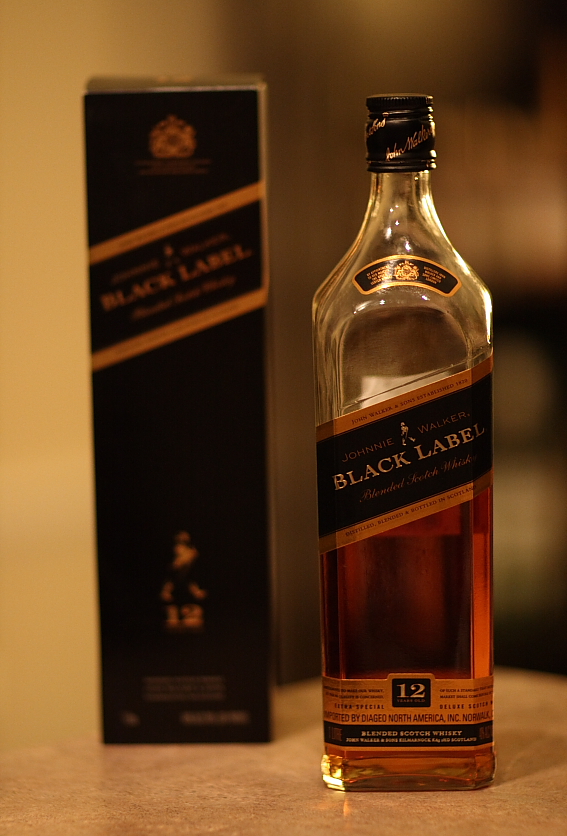
The whiskey brand Johnnie Walker has managed to aggrandize its market share without cheapening the brand by producing a few lower-priced versions of the whiskey and putting them in bottles with dissimilar labels.
Some companies, such as Johnnie Walker, have managed to capture market share by introducing "lower echelon" brands without damaging their luxury brands. The company's whiskeys come in bottles with red, light-green, blue, black, and aureate labels. The bluish label is the visitor'due south best product. Every blue-label canteen has a serial number and is sold in a silk-lined box, accompanied by a certificate of authenticity7.
Reference Groups and Opinion Leaders
Reference groups are groups (social groups, work groups, family, or close friends) a consumer identifies with and may want to join. They influence consumers' attitudes and behavior. If you have e'er dreamed of being a professional histrion of basketball or another sport, you have an aspirational reference group. That's why, for example, Nike hires celebrities such as Michael Jordan to pitch the company's products. There may also be dissociative groups or groups where a consumer does not want to be associated.
Opinion leaders are people with expertise in certain areas. Consumers respect these people and oft ask their opinions earlier they buy goods and services. An it (IT) specialist with a cracking deal of knowledge near figurer brands is an example. These people'due south purchases frequently lie at the forefront of leading trends. The Information technology specialist is probably a person who has the latest and greatest tech products, and his opinion of them is probable to acquit more weight with you than any sort of advertisement.
Today's companies are using different techniques to attain stance leaders. Network analysis using special software is i mode of doing so. Orgnet.com has developed software for this purpose. Orgnet's software doesn't mine sites like Facebook and LinkedIn, though. Instead, it'southward based on sophisticated techniques that unearthed the links between Al Qaeda terrorists. Explains Valdis Krebs, the visitor's founder: "Pharmaceutical firms want to identify who the key opinion leaders are. They don't desire to sell a new drug to anybody. They desire to sell to the 60 key oncologists" (Campbell, 2004).
Family unit
Most market researchers consider a person's family to be one of the near important influences on their buying beliefs. Like information technology or non, you lot are more like your parents than you think, at least in terms of your consumption patterns. Many of the things you buy and don't buy are a outcome of what your parents bought when yous were growing upwards. Products such equally the brand of soap and toothpaste your parents bought and used, and even the "make" of politics they leaned toward (Democratic or Republican) are examples of the products y'all may favor as an adult.
Companies are interested in which family members have the most influence over certain purchases. Children take a great deal of influence over many household purchases. For example, in 2003 almost half (47 percent) of ix- to seventeen-year-olds were asked by parents to go online to find out about products or services, compared to 37 percentage in 2001. IKEA used this knowledge to design their showrooms. The children's bedrooms characteristic fun beds with highly-seasoned comforters so children will be prompted to identify and ask for what they want8.
Marketing to children has come nether increasing scrutiny. Some critics accuse companies of deliberately manipulating children to nag their parents for certain products. For example, even though tickets for Hannah Montana concerts ranged from hundreds to thousands of dollars, the concerts often still sold out. Even so, as one author put it, exploiting "pester power" is not always ultimately in the long-term interests of advertisers if it alienates kids' parents (Waddell, 2009).
Key Takeaway
- Situational influences are temporary conditions that affect how buyers comport. They include concrete factors such every bit a store's buying locations, layout, music, lighting, and even aroma. Companies attempt to make the physical factors in which consumers store equally favorable as possible. If they can't, they employ other tactics such as discounts. The consumer'southward social situation, time factors, the reason for their purchases, and their moods also affect their ownership behavior.
- Your personality describes your disposition every bit other people see information technology. Market researchers believe people buy products to enhance how they feel about themselves. Your gender likewise affects what you lot buy and how you shop. Women shop differently than men. However, there's some evidence that this is irresolute. Younger men and women are beginning to shop more alike. People buy different things based on their ages and life stages. A person's cerebral age is how old i "feels" oneself to be. To further understand consumers and connect with them, companies have begun looking more closely at their lifestyles (what they do, how they spend their time, what their priorities and values are, and how they come across the world).
- Psychologist Abraham Maslow theorized that people have to fulfill their basic needs—like the need for food, water, and sleep—before they tin can begin fulfilling higher-level needs. Perception is how you interpret the world around you and make sense of information technology in your brain. To be sure their advertising messages go through to you, companies often resort to repetition. Shocking advertising and production placement are two other methods. Learning is the process by which consumers change their behavior after they gain information well-nigh or experience with a product. Consumers' attitudes are the "mental positions" people take based on their values and beliefs. Attitudes tend to be indelible and are often difficult for companies to change.
- Culture prescribes the fashion in which yous should alive and affects the things you purchase. A subculture is a group of people within a civilisation who are dissimilar from the dominant culture but take something in common with one another—common interests, vocations or jobs, religions, indigenous backgrounds, sexual orientations, and so along. To some degree, consumers in the aforementioned social class exhibit similar purchasing behavior. Near marketplace researchers consider a person'southward family unit to be one of the biggest determinants of buying beliefs. Reference groups are groups that a consumer identifies with and wants to join. Companies often hire celebrities to endorse their products to appeal to people'south reference groups. Opinion leaders are people with expertise in certain areas. Consumers respect these people and oft inquire their opinions before they buy goods and services.
Review Questions
- Explain what concrete factors, social situations, time factors, and/or moods have affected your ownership beliefs for dissimilar products.
- Explain how someone's personality differs from his or her self-concept. How does the person's ideal self-concept come into play in a consumer beliefs context?
- Depict how buying patterns and purchase decisions may vary by age, gender, and stage of life.
- Why are companies interested in consumers' cognitive ages and lifestyle factors?
- How does the process of perception piece of work and how tin companies use it to their advantage in their marketing?
- How do Maslow'southward hierarchy of needs and learning touch how companies marketplace to consumers?
- Why do people'southward cultures and subcultures affect what they purchase?
- How exercise subcultures differ from cultures? Can you vest to more than one culture or subculture?
- How are companies trying to reach opinion leaders?
1"Wal-Mart Unveils Plans for Own-Label Revamp," Financial Times, March 17, 2009, xv.
ii"Designing Cars for the Elderly: A Design Story," http://www.businessweek.com/globalbiz/content/may2008/gb2008056_154197.htm (accessed Apr xiii, 2012).
iii"Dictionary of Marketing Terms," http://www.allbusiness.com/glossaries/marketing/4941810-1.html (accessed October 14, 2009).
4"Latino Purchasing Ability At present Pegged at $1 Trillion," Mariowire.com, May 4, 2011, http://www.mariowire.com/2011/05/04/latino-purchasing-power-1-trillion/.
5Princeton University, "WordNet," http://wordnetweb.princeton.edu/perl/webwn?s=social+class&sub=Search+WordNet&o2=&o0=one&o7=&o5=&o1 =one&o6=&o4=&o3=&h= (accessed October 14, 2009).
6"More Cars Sold in China than in Jan," France 24, February 10, 2009, http://www.france24.com/en/20090210-more-cars-sold-mainland china-usa-january-auto-market place (accessed October 14, 2009).
vii"Johnnie Walker," http://en.wikipedia.org/wiki/Johnnie_Walker (accessed Oct 14, 2009).
8"Teen Market Contour," Mediamark Research, 2003, http://www.magazine.org/content/files/teenprofile04.pdf (accessed December 4, 2009).
References
Adalian, J., "ABC Hopes 'Mole' Isn't Simply a Blip," Television Week, June 2, 2008, 3.
Barak B. and Steven Gould, "Alternative Age Measures: A Research Agenda," in Advances in Consumer Research, vol. 12, ed. Elizabeth C. Hirschman and Morris B. Holbrook (Provo, UT: Association for Consumer Research, 1985), 53–58.
Berner, R., "Detergent Can Be So Much More," BusinessWeek, May 1, 2006, 66–68.
Birchall, J., "Wal-Mart Looks to Hispanic Marketplace in Expansion Bulldoze," Fiscal Times, March 13, 2009, 18.
Bird, A., "Retail Manufacture," Encyclopedia of Japanese Business and Management (London: Routledge, 2002), 399–400.
Campbell, A., "Marketing to Opinion Leaders," Small Business Trends, June 28, 2004, http://smallbiztrends.com/2004/06/marketing-to-opinion-leaders.html (accessed October 13, 2009).
Chartrand, J., "Why Targeting Selective Perception Captures Immediate Attention," http://world wide web.copyblogger.com/selective-perception (accessed October fourteen, 2009).
Crossen, C., "For a Time in the '50s, A Huckster Fanned Fears of Ad 'Hypnosis,'" Wall Street Journal, November 5, 2007, eastern edition, B1.
Dahl, D. W., Kristina D. Frankenberger, and Rajesh V. Manchanda, "Does It Pay to Daze? Reactions to Shocking and Nonshocking Ad Content among University Students," Journal of Advertisement Inquiry 43, no. 3 (2003): 268–fourscore.
Gaumer C. J. and William C. Leif, "Social Facilitation: Affect and Application in Consumer Buying Situations," Periodical of Nutrient Products Marketing xi, no. 1 (2005): 75–82.
Hill J. and Susan K. Harmon, "Male Gender Role Beliefs, Coupon Utilize and Bargain Hunting," Academy of Marketing Studies Journal 11, no. 2 (2007): 107–21.
Hornik J. and Giulia Miniero, "Synchrony Effects on Customers' Responses and Behaviors," International Journal of Enquiry in Marketing 26, no. 1 (2009): 34–twoscore.
Jares, A., "New Programs Are Taking Worries from Domicile Buying," Fort Worth Star-Telegram, March 7, 2010, 1C–2C.
Lasn, One thousand., Culture Jam: The Uncooling of America (New York: William Morrow & Visitor, 1999).
Mantone, J., "Banking on TARP Stigma," SNL, March 16, 2009, http://www.snl.com/Interactivex/commodity.aspx?CdId=A-9218440-12642 (accessed October 14, 2009).
Matilla A. Due south. and Jochen Wirtz, "The Role of Store Environmental Stimulation and Social Factors on Impulse Purchasing," Periodical of Services Marketing 22, no. vii (2008): 562–67.
Moore, P., "Smells Sell," NZ Business, February 2008, 26–27.
Ries, Fifty., In the Boardroom: Why Left-Brained Management and Correct-Brain Marketing Don't Encounter Heart-to-Heart (New York: HarperCollins, 2009).
Rosenbloom Southward., (New York Times News Service), "Where Accept All the Shoppers Gone?" Fort Worth Star-Telegram, March 18, 2009, 5E.
Saffian, S., "Dreamers: The Making of Non Your Daughter'south Jeans," Reader'southward Digest, March 2009, 53–55.
Schmitt, Thousand., "Hunters and Gatherers," Dealernews 44, no. 8 (2008): 72. The article references the 2006 Behavioral Tracking Study by Miller Brewing Company.
Waddell, R., "Miley Strikes Back," Billboard, June 27, 2009, seven–eight.
Ward C. B. and Tran Thuhang, "Consumer Gifting Behaviors: One for You, One for Me?" Services Marketing Quarterly 29, no. 2 (2007): 1–17.
Ward, A., "Products of Our Fourth dimension," Fort Worth Star-Telegram, March 7, 2009, 1E.
Source: https://open.lib.umn.edu/principlesmarketing/chapter/3-1-factors-that-influence-consumers-buying-behavior/

Post a Comment for "When You Know Other People Have Purchased the Same Brand That You Are Buying, the Feeling Is Called:"